Build the world

Worldbuilding that stays connected to the story

Keep the facts behind your fiction in a codex that can sit beside the manuscript. Mythwrites gives places, people, systems and objects a shared home instead of leaving canon scattered across notes.

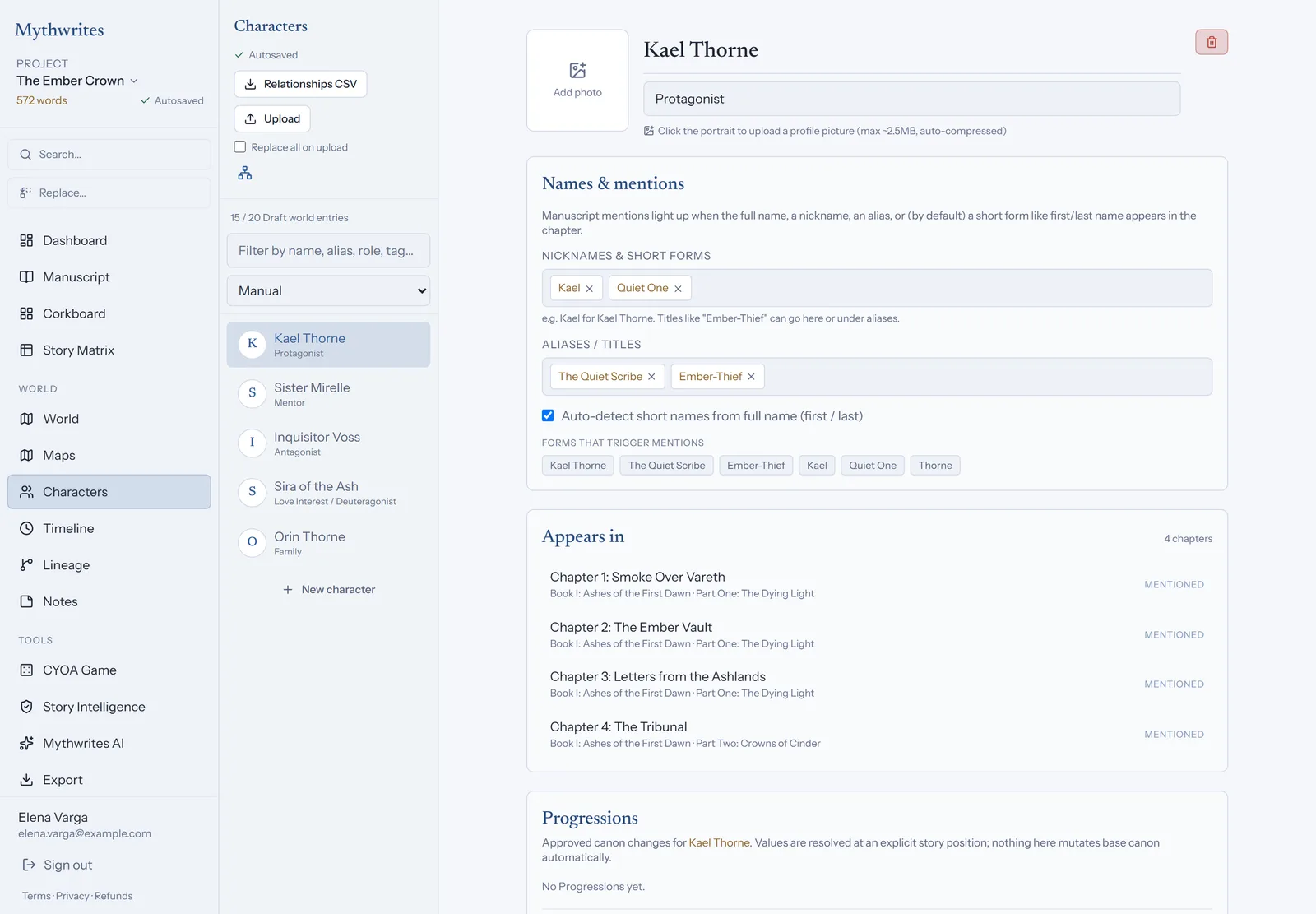
Mythwrites character sheet for Kael Thorne showing aliases, mention forms, traits, and exact chapter appearances.
Character and world codex: track every detail, alias, and mention form directly linked to the manuscript.

A codex for the details that matter

Create character sheets and world entries for the information your story depends on. Locations, lore, magic systems, races, organizations and items can be organized as part of the same project.

The goal is not to prescribe one worldbuilding method. It is to make the details you have already decided easier to find while you draft.

  • Characters and labeled relationships
  • Locations, lore and custom world entries
  • Magic systems, races, organizations and items

Maps and relationships

Use maps for spatial context and a relationship view for the links between characters. These are working views of the project, not a replacement for the prose that makes the world feel real.

Connected references help you move from a location or person back to the chapters where the story uses them.

Make canon easier to check

World information can inform story intelligence and continuity review. When the system surfaces a possible contradiction, the supplied evidence and uncertainty remain visible for your judgment.

Mythwrites does not promise perfect canon detection. It gives you another way to inspect relationships that are difficult to hold in your head as a project grows.

Room for different kinds of fiction

The worldbuilding toolkit includes fantasy-friendly concepts such as magic and races, but the workspace is for fiction broadly. Use the fields that fit your story and leave the rest out of your process.

Worked Writer Example

Enforcing Hard Magic System Limits

Scenario: In your world bible, you established that Bloodstone Magic requires physical touch and exhausts the caster's stamina for twenty-four hours after invocation.

The Problem: Sixty chapters and four months of drafting later, a climactic battle scene depicts your protagonist casting two Bloodstone spells in consecutive minutes from fifty yards away across a raging river.

Valen raised his hand across the chasm, unleashing a second searing crimson burst from the Bloodstone...

How Mythwrites Resolves It: Because Bloodstone was written up as a Magic entry in the Mythwrites World Codex, with its range and cooldown spelled out in the entry's rules and limitations fields, that text is part of what a continuity review reads. Run one on the chapter and Story Intelligence can surface the range violation and the consecutive-cast contradiction as a finding for you to weigh, evidence and uncertainty included, before you finish the draft.